Category: Technical Guide | Tags: workholding, CNC fundamentals, fixtures, vises, clamping, setup
Workholding is the often-overlooked foundation of CNC machining quality. No matter how sophisticated your machine, your tooling, or your programming, a part that moves during cutting — or that is positioned inconsistently from setup to setup — will not meet specification. This guide covers the full landscape of CNC workholding, from the simplest vise to engineered custom fixture systems.
What Is Workholding and Why Does It Matter?
Workholding encompasses every device and method used to locate, support, and clamp a workpiece during machining. Its job is to resist cutting forces, hold the part in a precise and known position, and do so repeatedly and reliably — across hundreds or thousands of production cycles if necessary.
The consequences of inadequate workholding cascade through the entire manufacturing process. Parts that shift during cutting produce scrapped material and rework. Setups that vary from part to part produce dimensional variation that triggers quality holds. Fixtures that are slow to change over consume machine time that could be productive. Getting workholding right is foundational to everything else in a precision machining operation.
The Workholding Hierarchy
General-Purpose Workholding
The entry point for most machining operations. Precision machine vises, step clamps, toe clamps, and T-slot clamping sets fall into this category. These are versatile, cost-effective, and adequate for a wide range of applications at low to medium volumes. Setup requires skilled measurement and indication to locate the part accurately.
Best for: Prototype work, low volumes, job shop environments, parts with simple geometry.
Modular Fixturing Systems
Modular systems use a grid plate or T-slot base with standardized components — locating pins, clamps, supports, and spacers — that can be reconfigured for different parts. They bridge the gap between general-purpose clamping and dedicated custom fixtures.
Best for: Medium-mix environments, repeat jobs not quite high enough volume to justify dedicated fixtures, operations with frequently changing part families.
Zero-Point Clamping Systems
Zero-point systems use a receiver plate permanently mounted to the machine table and standardized chuck or pallet systems that locate on precision ground references. Setup is reduced to dropping the workpiece-holding element onto the receiver, where it locates to sub-0.01mm repeatability and is pneumatically or mechanically clamped.
Best for: High-mix, repeat-order environments where setup time is a significant cost driver across a wide variety of parts.
Dedicated Custom Fixtures
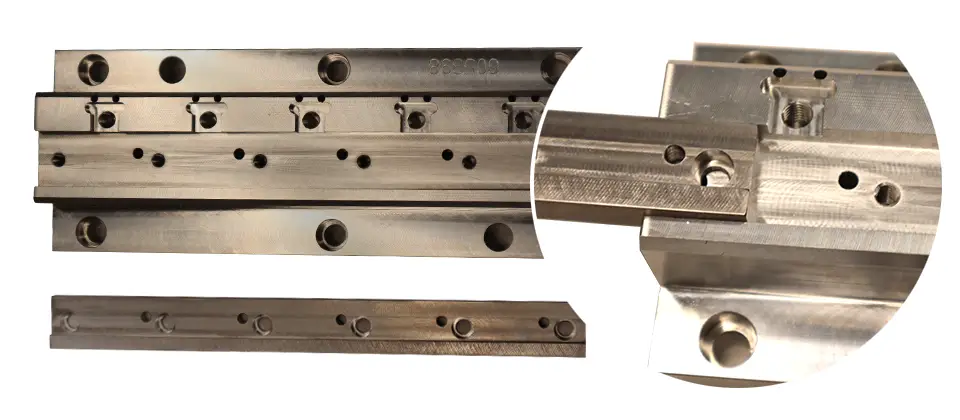
At the top of the workholding hierarchy are custom-engineered fixtures designed specifically for one part or a closely related family of parts. They incorporate precision locators referencing defined datums, purpose-sized clamping elements, chip clearance features, and often multiple part positions in a single fixture body.
Best for: High-volume production, tight-tolerance parts, parts requiring multi-face access, operations where setup time significantly impacts throughput.
Read more: Benefits of Custom Workholding Fixtures for High-Volume Production
Core Workholding Design Principles
The 3-2-1 Locating Principle
Three contact points establish the primary plane, two contact points on a secondary surface constrain two more degrees of freedom, and one contact point on a tertiary surface constrains the final one. The result is a fully constrained workpiece located unambiguously in space — the same way, every time. Every good fixture design traces back to a valid 3-2-1 scheme.
Datum Selection
Datums should be selected based on functional requirements — the features that most critically define part performance should be used as references wherever possible. Working from functional datums means the features most critical to part performance are controlled directly, rather than through a chain of dimensions from arbitrary reference surfaces.
Clamping Force and Direction
Clamps should be positioned to resist cutting forces, not fight them. A clamp placed directly opposite the primary cutting force provides maximum rigidity. For thin-walled or flexible parts, support must be provided near the cut to prevent deformation under clamping load.
Fixture Materials and Construction
Fixture bodies are typically machined from tool steel, hardened steel, or aluminum depending on production volume and required durability. High-volume fixtures for demanding applications use hardened and ground steel for maximum wear resistance. Locating elements — pins, seats, and pads — are almost always hardened steel regardless of the fixture body material, and locating surfaces are precision ground for accuracy.
A well-built production fixture is designed to run for hundreds of thousands of cycles. Maintenance typically involves periodic inspection and replacement of wear surfaces rather than full replacement of the fixture body.
Workholding for Specific Industries
Automotive Manufacturing
Automotive components demand high-volume throughput, tight tolerances, and full SPC compliance. Multi-station fixtures, hydraulic clamping for consistent force, and poka-yoke features that prevent incorrect loading are standard in high-volume automotive workholding programs.
Aerospace and Defense
Aerospace fixturing prioritizes material traceability, documented datum schemes, and the ability to machine complex geometries in as few setups as possible. Fixtures are documented in detail and qualified through a formal first-article inspection process.
Medical Devices
Medical fixturing requires cleanliness, material compatibility with cleaning agents, and part protection from marring or deformation. Soft-jaw systems, delrin contact pads, and vacuum fixturing are common. Traceability requirements often dictate that fixture qualification is formally documented.
Real-World Results: What Good Workholding Delivers
When a Michigan Tier 2 automotive supplier partnered with Focal Point CNC Solutions to replace manual vise setups with a precision two-station fixture, setup time dropped from 38 minutes to 5 minutes per part — an 87% reduction. First-pass yield improved from 93% to 99.1%. The fixture paid for itself within two weeks of production.
Working with a Fixture Builder
The most productive fixture development engagements start early — ideally when the part design is still in progress. Early fixture design review can identify features that are difficult or expensive to hold and fixture, before they are locked into the design.
When engaging a fixture builder, come prepared with your part drawing, your tolerances and critical features called out, your production volume and machine information, and any known constraints around cycle time or setup frequency. A good fixture builder will propose a datum scheme for your review and model the fixture before any material is cut.
Your Precision Workholding Partner in Flint, Michigan
Focal Point CNC Solutions provides complete custom workholding design and fabrication services for manufacturers across the Midwest. From concept through qualification, we engineer fixtures that solve real production challenges. Located at 3034 S. Ballenger Highway, Suite B, Flint, MI 48507.
Call 810-869-8336 Request a Quote